Mental Health vs Mental Toughness & Why Therapy Culture Makes You Weaker
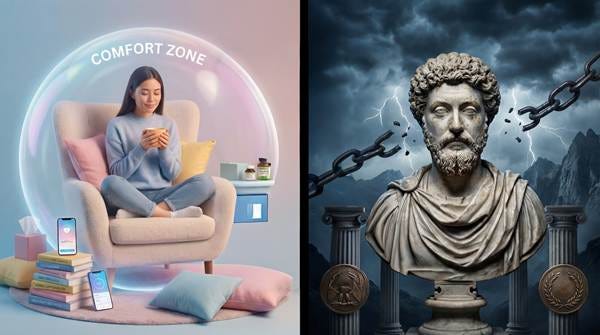
I was reading an article on Forbes today, where a psychologist shares a science inspired quiz to test if you are a modern Stoic. It was published today, 23rd of December 2025. The article dives into how ancient Stoic wisdom is surging in popularity. Why? Because it offers resilience training as a fresh alternative to the endless cycle of conventional therapy that usually leads … nowhere.
Mental health awareness is a growing issue that has become a priority in today’s society; yet, there are still many people who choose to follow the stoic philosophies of Marcus Aurelius and Epictetus instead of seeking help from a therapist. Why is this? Let’s take a closer look at the reasons behind this trend.
I have spent decades exploring ancient origins, philosophies and religions and spirituality from multiple perspectives and of course the human condition. I have seen this shift firsthand. My posts like “Why Suffering Makes You Stronger“ and “Positive Thinking Wrong?“ struck a chord with thousands, sparking debates that cut to the core of modern fragility.
Today, I’m here to argue something controversial: Our exploding therapy culture, that is extremely profitable, is actually making us weaker. But don’t worry; I’ll back it up with evidence, ancient wisdom, and a dash of provocation to keep you hooked.
The Therapy Boom is A Double-Edged Sword

Let’s start with the facts. Over the last decade, therapy has gone mainstream. It used to be a discreet appointment for the truly troubled ones. But now it has become a badge of honour. From apps like BetterHelp and Talkspace that are downloaded in billions, and the social media influencers hosting “self-care Sundays” plus the journaling prompts and trauma unpacking. According to recent data, Americans are spending over $300 billion annually on mental health care. And … surprise surprise, the rates of anxiety, depression, and overall dissatisfaction are skyrocketing. Why? Because therapy culture instead of being a tool for healing, has been transformed into a lifestyle that pathologizes every emotion.
And please, do not get me wrong here. Therapy, assuming you find a really good therapist which is rare, has its place. Evidence-based approaches like Cognitive Behavioral Therapy (CBT) can indeed rewire negative thought patterns, reduce depression, and improve relationships, assuming that you put in the work. So, for those grappling with severe trauma or clinical disorders, professional help is invaluable, because these persons are so deep within these disorders that are unable to see within and therefore take action. Another example is interpersonal therapy, that helps express emotions healthily and build supportive networks. But here is the problem. What started as targeted intervention has ballooned into a cultural phenomenon where everyday discomforts, from breakups, to job stress, or even mild sadness, are labelled as “mental health crises.” And the result is common sense: this over-medicalization is turning resilient humans into perpetual patients, unable to do the work themselves. And the truth is, and has always been, that If you do not do the work on yourself, nobody can do it for you, especially when, most of the time, you blindly follow whatever you are told without any critical thinking. It has essentially become a modern cult.
For that reason, there are plenty of critics, including journalists and psychologists, who are sounding the alarm.
Therapy culture results to a “rising fragility,”. An ordinary discomfort is reframed as trauma, and accountability is sidelined for emotional safety. And your ‘boundaries’, you know the little boxes we close ourselves in, become smaller and smaller.
This means that we become more and more delusional, living in a bubble, within a support group that …. makes the bubble stronger, completely disconnected from reality.
One op-ed in The Hill argues that this mindset is fuelling America’s unrest, creating a society of victims rather than victors. Even Gen Z, the generation most vocal about mental health, is paradoxically viewing therapy as a sign of weakness despite their crisis.
I have seen, in my own explorations of ancient wisdom, how this contrasts sharply with historical approaches to the human psyche. Look at the ancients and you will see that they didn’t coddle emotions. They just mastered them.
How Therapy Culture Undermines Your Strength
Now, for the controversial part, therapy culture is clearly ineffective. Look around you and you will see that. But more than that, it’s actively making us weaker. How? By encouraging endless introspection and labelling every setback as a “trigger,” it erodes our natural resilience. I addressed this issue in my article ‘Your triggers are your responsibility’.
A Newsweek opinion piece just nails it: Despite the therapy boom, we’re “growing sicker, weaker, and more divided.” Why? Because constant rumination amplifies problems rather than solving them. This should be common sense. But we know that common sense today is becoming an endangered species.
Take the example of “bad therapy“ in parenting, an extraordinary book. Author Abigail Shrier argues that overemphasizing vulnerability sends kids the message: “You are weak and unable to solve your own problems.” But this extends to adults too. In a Reddit thread that went viral, users debated how therapy lingo like “boundaries” and “toxic” has made people worse at handling interpersonal conflicts, opting for avoidance over resolution. Are you surprised? UnHerd repeats this, claiming that therapy culture is fuelling the youth mental health crisis by pushing narratives that treatment is universally good, ignoring its limitations and the potential harm.
From my perspective this mirrors a broader societal shift. In my post “Why Suffering Makes You Stronger,“ I argued that adversity isn’t something to therapize away. Through adversity a character is forged. My readers resonated because it challenged the positivity cult, much like my “Positive Thinking Wrong?“ piece, where I critiqued blind optimism for ignoring reality. It is the same with therapy, where it often promotes a similar delusion: That we can talk our way out of pain without confronting it head-on. But as David Brooks writes in The Salt Lake Tribune, this results to weakness by fixating on past wounds instead of building future strength. And I have seen this in abundance in just in my surrounding environment, without even going to the social media chaos.
Even therapists, the good ones, are critiquing the trend. Dr. Samantha Boardman calls therapy culture “toxic” because it turned treatment into a trend, risking overdependence. WBUR’s On Point podcast questions if we’ve taken it too far, medicalizing normal human experiences. And what is the result? A generation less equipped for life’s inevitable hardships, more prone to fragility than fortitude.
Stoicism as The Antidote of Emotional Resilience

Now, let’s contrast this with Stoicism. This amazing ancient philosophy that’s recently (thank God) is experiencing a renaissance. As the Forbes article highlights, Stoic principles align perfectly with modern psychology. Stoicism emphasizes that we suffer more from our interpretations than the events themselves. At its core, Stoicism teaches emotional resilience through practices such as the dichotomy of control, which says: Focus on what you can influence (your actions, judgments) and accept what you can’t (external outcomes). A simple and yet powerful principle.
It is a fact that key Stoic strategies build mental toughness. For example, embracing adversity as an opportunity for growth develops resilience by integrating hardship into your life story. Even Marcus Aurelius kept reminding himself: “Choose not to be harmed and you won’t feel harmed.”. Modern therapy will call this suppression. But it is absolutely no. It is called governance! Stoics like Socrates outlined simple resilience tactics such as: View misfortune philosophically so that you avoid excessive grief.
As for modern applications? They abound. Stoicism encourages challenging negative thoughts, developing emotional intelligence, and cultivating virtues like commitment and confidence. A YouTube breakdown of “The Art of Resilience” lists seven principles, including process-oriented thinking and detachment from results. What this does, is building unbreakable strength, and as Steve Burns puts it: “Become Unbreakable Through Stoicism.”
Now, if I look into these principles as an engineer, Stoic mindfulness, that is being present without judgment, mirrors advanced algorithms that filter noise for signal. And it is pretty practical: During tough times, ask, “What is required of me right now?” This redirects energy from emotional spirals to action. After all, emotions are the result of thoughts, stored in our body, and most of the times are completely disconnected from reality. They are in our thoughts though, so it is a (delusional) reality for us. Analyse your thoughts, disconnect from your emotions to see the pattern clearly, and they are gone.
Stoicism vs. Therapy, Who Wins?

The real debate is how to approach this topic from two very different perspectives. On the one hand, proponents of Stoicism will argue that Stoicism complements therapy. After all CBT is directly derived from Stoicism, with the principle being that identifying one’s own thoughts helps shape their emotional response. In fact, according to a 2005 article published in Plato’s Academy, “Stoicism is the ancient operating system for present day therapeutic practice.”
On the flip side, those critical of Stoicism, support that the suppression of emotions can lead to social disconnection/isolation and avoidance of getting help, labelling it as “dangerous”. But this is not Stoicism.
In my opinion, I believe for the majority of individuals, Stoicism will always triumph over therapy as a method of self-empowerment versus dependency on others or outside sources.
We know that the idea of mental toughness yields benefits including enhanced performance, increased self-esteem, improved problem-solving skills, etc. and these benefits are factual. For individuals suffering from mental disorders or those who have reached rock bottom, therapy can help with managing symptoms; however, another major difference between Stoicism and therapy is that Stoicism creates long-term resiliency, while the principles of Stoicism have also been shown to correlate with greater life satisfaction and peace of mind.
An example of how Stoicism could be utilised as a method of therapy during a marital crisis, would involve focusing on empowering each other through a supportive system, rather than the focus in therapy which is on the emotional wounds of an individual – and that’s why it rarely works...
The Forbes quiz underscores this growing interest:
Stoicism’s science-backed appeal lies in its practicality for modern stress.
Personal Reflections & Conclusion
At a personal level, I try to apply Stoicism to my life as much as possible. Over the past few years, I’ve faced physical and mental trials that therapy could not prepare me for, yet Stoic resilience did. At the same time I have seen the results of therapy in others. How they have become trapped in a small bubble; how they developed extreme narcissism, avoid responsibility, and lack accountability; and how words like “boundaries”, “triggers”, “self-care”, “gaslighting”, “controlling” and “toxic” have become their own prison. I could never have imagined how delusional someone can become when they depend on a third party that lacks the insights and understanding only you can have about yourself, not to mention that this person has spoken only to you and not to anyone else you accuse. After all, as I mentioned before, it is a cult, and in a cult, you become dependent and delusional.
In conclusion:
Suffering isn’t to be avoided, it is the catalyst for strength. Positive thinking is flawed if it denies reality. And these ideas resonate because they counter therapy’s softness with tough love.
So, in 2025, as Forbes spotlights Stoicism’s rise, it’s time to rethink our approach. Therapy culture, for all its intentions, often weakens us by promoting fragility. On the other hand, Stoicism, with its emphasis on resilience, offers a path to true strength. Yes it is controversial, but substantiated.
My suggestion, mirrors Marcus Aurelious and many others, and it is:
Embrace suffering, master your mind, and watch yourself grow unbreakable.


I loved Reading this piece. So many perspectives.
Ioannis, I'm so glad that you're exposing readers to what may be described as 2nd hand systems that detract rather than achieve. To support your writings I offer complementary comments from my own experiences and observations that go back ninety years. For me, Vedic yogic techniques are ageless, boundless and offer humanity the ultimate means to self-discovery and disease-free living. My experiences in Psychiatry offer practical approach to undo the harm that modern living norms have imposed on them. Together they form the basis of a lifestyle, fit for modern times.