

It’s highly unlikely that any therapist, life coach, or so-called thought leader on LinkedIn would ever tell you this, but it’s a message that has been quietly conveyed by every major wisdom tradition since the dawn of humanity:
Your feelings are lying to you.
Not sometimes or only under extreme circumstances (like when you are emotionally or physically fatigued, for example), but … by design.
Your strongest emotional experience (which you perceive as completely ‘real’) is simply an impression created by a conditioned mind that confuses noise generated by that same mind as ‘truth.’
And this is not cynicism, it represents the most liberating concept of thought throughout history…
In this article, we will examine what four major traditions, the Tibetan Book of the Dead, the Upanishads, Rumi’s Sufi poetry, and the Stoic philosophy of Marcus Aurelius. We will see what they actually teach about the nature of emotion.
We will also look at what Carl Jung, one of the 20th century’s most rigorous psychologists, concluded after decades of clinical work and his famous study of the Tibetan text:
Not that emotions are mystical phenomena to be revered, but that they are psychological projections, or the unconscious mind’s way of painting its own unresolved contents onto the world and mistaking the canvas for reality.
This of course is not some mumbo jumbo metaphysics. It is, as we will see, closer to what modern cognitive science is only now beginning to confirm.
What the Traditions Actually Discovered
“The Tibetan Book of the Dead” - an exceptionally advanced psychological text - describes how consciousness exists after death. During this state of* transition between many existences,* (i.e.’between life and another life) the deceased encounters horrifying and terrifying demon-like forms of monstrous, anger-filled beings that spread throughout the bardo (the name for the transitional state between lives) and radiate from themselves/fire & darkness.
The instruction provided repeatedly throughout the book is very clear and explicit:
“Do Not Be Afraid.”
The demons whom we perceive to be demons are not alive, but are rather illusions that manifest is us from our repressed fears. Thus it can be said that our repressed fears are those demons we have encountered during our lifetime. They may be anger, guilt, grief, shame, and unresolved fear; when all the distractions/illusion of everyday life for us no longer exist, we can see them for all they really are. This is the purpose of this book.
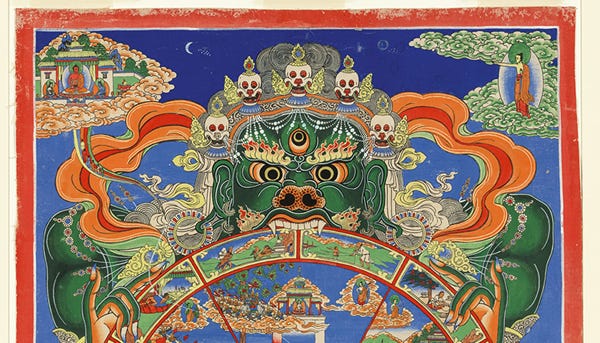
The Upanishads, which were composed long before Freud’s time (over 3,000 years ago), were describing the same thing with different words. The Upanishads teach us that our perception of the world (including our emotional world) is called “maya” or “great illusion”. While maya is not a lie or untrue in that sense, it does not reflect reality- it is a product of who we are. Our angry feelings, loving feelings and grieving feelings are only the surface of something more deep (Atman) - pure witnessing awareness that exists prior to the experience of emotion and continues after the experience has passed.
Carl Jung arrived at this same conclusion from the opposite angle. He called it projection. Jung stated that we do not see the world as it truly is, but rather, we see it as we are. Strong emotions signal not our relationship to the external world, but rather what is inside us in the form of the unconscious; this includes the “Shadow”, “Anima”, and the separate parts of ourselves that remain uncomprehended.
The best example of this is the following quote by the 13th Century Persian poet and Sufi mystic Rumi:
“There is a place beyond wrong and right; I will meet you there.”
The place that Rumi was talking about is the space before any emotional reaction or identification by the brain occurs. In other words, the space before one’s mind determines that whatever experience took place was an injustice, an attack that must be responded to with fear and/or a loss that should cause a person to grieve.
The Problem With “Emotional Intelligence”
The way emotional intelligence has been interpreted and understood in contemporary society is very different from how it was understood in ancient cultures such as Stoicism or Buddhism.
The modern definition of emotional intelligence assumes that emotions can be trusted, and that feeling emotions more deeply and expressing them in an authentic manner will lead to greater wisdom when it comes to making decisions.
This assumption is completely wrong.
For example, if you are feeling a surge of anger because you believe that an injustice was done to you, that is not an indicator that an injustice occurred; it is an indicator that you have reacted to an event in a way that your background and personal history have influenced you to do so. In short, the surge of anger you feel is a reaction that has occurred due to your body’s reaction to a specific event, not an indicator of a situation w/ an injustice.
Marcus Aurelius (a Stoic philosopher) understood that all emotions are real, but not all emotions are accurate. Marcus Aurelius did not advise people to simply “feel their emotions.” He wrote that there exists a gap between the stimulus and the emotional response, where an individual has the ability to choose to be free. The problem is not the emotion. The problem lies in the judgmental interpretation of the emotion; the belief and story created by the mind to explain the emotional experience and what is required from the individual.
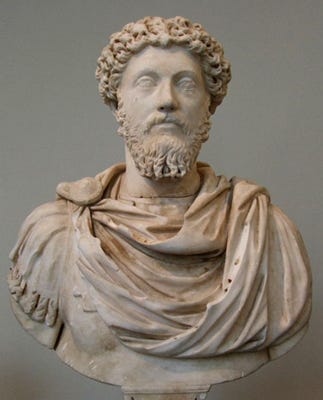
Bust of the Stoic philosopher and Roman Emperor Marcus Aurelius. (Public Domain / Metropolitan Museum of Art)
What Is Real, and What Is Not
To clarify: while the various wisdom traditions do hold that our emotions are not “fake” (i.e., they exist), they do not consider the symptoms created by our emotional responses (i.e., the physical sensations of the emotional experience) to be true representations of reality.
Although the sensations of anger can be clearly felt in the body, there is a lot of interpretation and meaning that goes into the creation of those sensations (e.g., the thought that we have been “disrespected”).
The sensations themselves are valuable and important to notice and acknowledge; however, the understanding of what we are feeling and why, will most likely be influenced by our conditioning and memories.
All wisdom teachings agree on this point:
The physical sensations we have when experiencing an emotion are true messengers of information that we should take notice of. The thoughts we have surrounding those physical sensations are actually a form of ego-defense at its core.
The Real Intelligence
What traditional practices provide us with instead of emotional intelligence is a higher standard; that is, the ability to witness the development of an emotion without becoming its prisoner.
To be clear, this does not suggest that we are suppressing the feeling - this is not what is meant by someone with a “stiff upper lip” who has learned to hide their true emotions while feeling uneasy inside. It is the genuine recognition, in the moment of the emotion’s arising, that you are not the emotion. You are the awareness in which the emotion appears. This is what the Tibetan masters called rigpa; pure, untouched awareness. What the Vedantists call sakshi; the witness. What Jung called Self-actualization.
The Tibetan Buddhist text Bardo Thodol provides us with a concise guide on what many call true emotional intelligence. When an overwhelming stimulus appears in one’s life or when he/she dies or when he/she has passed from this life, the message is clear; do not avoid it, do not succumb to it; do not assist in perpetuating the suffering it could produce. Observe this astonishing force as it unfolds within your consciousness. Allow the vastness of the awareness you were before it became visible to enter into your thoughts.
This is not a hoax. It’s the hardest yet most worthwhile feat you will accomplish upon your life’s journey.
By Dr Ioannis Syrigos