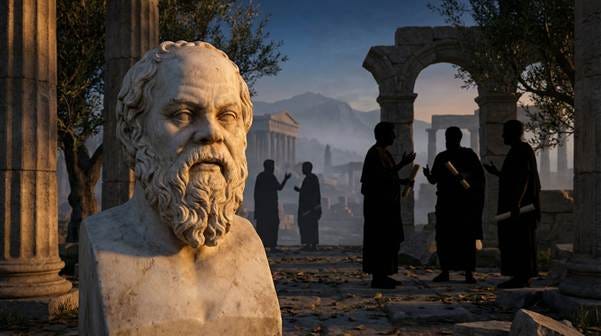
The Ship of Fools: Socrates' Warning Against Uninformed Democracy
“Until philosophers are kings, or the kings and princes of this world have the spirit and power of philosophy, and political greatness and wisdom meet in one, and those commoner natures who pursue either to the exclusion of the other are compelled to stand aside, cities will never have rest from their evils - no, nor the human race, as I believe - and then only will this our State have a possibility of life and behold the light of day.” - Plato, The Republic
In an age of populist fervour and digital discourse, where opinions are formed in the crucible of social media and political passions run high, it is sensible to turn to the wisdom of the ancients. The Athenian philosopher Socrates, as chronicled by his student Plato, offered a sharp critique of democracy that resonates with unnerving clarity in our modern world. He warned that democracy, in its purest form, carries within it the seeds of its own destruction, and that its natural successor is not a more perfect union, but tyranny. This is not a partisan critique, but a philosophical one, a caution against the perils of an uninformed electorate and the demagogues who would lead them astray.
The Socratic Critique: A Ship of Fools
The scepticism Socrates held regarding democracy was not rooted in elitism but rather in his strong respect for knowledge and competence. In Plato’s Republic , he likens the state to a ship and questions, “Who would you want to select the captain of your ship?” Would you choose someone based solely on popularity? Or would you choose someone who makes grand promises? Or would you want someone who has studied the art of navigation and understands the stars, winds, and currents? The answer to this question is obvious; however, Socrates believed that in democratic government, we are allowing the ship of the state to be captained by the irrationalities of the masses rather than the educated or knowledgeable. Socrates believed this could lead to a “ship full of fools,” and that the most persuasive, charismatic, and deceitful people would take control of the ship of the state, leading it down a path to destruction.
Expanding on Socrates’ ideas, Plato proposed a deteriorating cycle of government moving from the ideal government of aristocracy (government run by the best) through timocracy (government run by the honorable) through oligarchy (government run by the wealthy) to democracy (government run by the masses). According to Plato, democracy is characterized by an insatiable desire for freedom and equality , and therefore will slip into an anarchic state. In such a state, the people become tired of chaos, and thus will call out for a strong leader to restore order. And it is from this cry that the tyrant emerges.
The Rise of the Tyrant
The tyrant, according to Plato, is a product of democracy’s excesses. He presents himself as a champion of the people, a protector of the common man against the elites. He is a master of rhetoric, a weaver of words who can stir the passions of the masses and turn them against his enemies. Once in power, he consolidates his rule through a combination of fear, division, and the appeasement of the basest desires of the populace. He surrounds himself with flatterers and sycophants, and eliminates anyone who dares to challenge his authority. He creates a climate of mistrust, where citizens are encouraged to spy on one another, and where loyalty is rewarded above all else.
Aristotle, another giant of classical philosophy, echoed and expanded upon these concerns in his Politics. He observed that tyrants often find support in unexpected quarters. In a chilling passage, he notes:
“Such are the power given to women in their families in the hope that they will inform against their husbands, and the license which is allowed to slaves in order that they may betray their masters; for slaves and women do not conspire against tyrants; and they are of course friendly to tyrannies and also to democracies, since under them they have a good time.”
This observation, while reflecting the societal norms of ancient Greece, contains a timeless truth about the nature of power. The tyrant seeks to atomize society, to break down the traditional bonds of family and community, and to create a direct relationship between himself and each individual. By empowering certain groups and turning them against others, he creates a web of dependency and control that is difficult to escape.
This is not to say that women or any other group are inherently drawn to tyranny. The great filmmaker and political commentator Orson Welles, a staunch anti-fascist who staged a production of Julius Caesar as a warning against the rise of Mussolini, understood that the appeal of the strongman is a complex phenomenon . It is often a response to a sense of powerlessness and a desire for order in a chaotic world. The tyrant promises to restore a sense of purpose and belonging, and for those who feel marginalized or ignored, this can be a seductive offer.
The Swiss Model: A Double-Edged Sword
People (including myself) have pointed to Switzerland’s direct democracy as a model of governance that is more stable and just than representative democracy. Although the Swiss system primarily relies upon direct participation through frequent referenda and popular initiatives, it gives the citizens an inordinate amount of power relative to most of the rest of the world. However, it is not without its own set of challenges. Voter turnout in Switzerland is often low, and there is no formal requirement for political education. This means that, as in any democracy, the potential for uninformed decision-making remains a significant concern.
While there is an obvious admirable aspect to Switzerland’s commitment to popular sovereignty, there is also a great deal of personal responsibility placed on each citizen. In addition, Switzerland cannot provide any assurance that the individual citizens will actually possess the necessary knowledge and experience to properly fulfil the obligations that are imposed upon them. Without an informed and engaged electorate, a democratic system, regardless of how well designed, is still vulnerable to the same potential problems as put forth by Socrates and Plato over 2000 years ago.
The Path Forward: A Return to Civic Virtue
There has been a great deal of debate regarding the optimal way to reduce the adverse effects of ignorance on our democratic institutions while preserving democracy. The classical idea of civic virtue provides us with a way forward, as individuals must be politically literate and have the ability to analyse and synthesize information when making their own decisions as informed voters.
This does not suggest that we should establish an epistocracy, in which only academically-educated individuals are permitted to govern. An epistocracy would be contrary to self-governance, and should not be considered a viable option. Rather, we must reinvest ourselves into civic education, both within our schools and within the public discourse, so our children are taught how to think, rather than simply being instructed on how to vote. A society comprised of reasoned individuals will promote dynamic conversation, and as a result, will also be able to hold their leaders to a higher standard regarding honesty, integrity, and intellectual rigor.
As Thomas Jefferson said:
“If a nation expects to be ignorant and free, in a state of civilization, it expects what never was and never will be.”
If we wish to preserve our liberties, we must heed this warning. We must become a nation of navigators, not a ship of fools, in order to better guide our society toward a successful and prosperous future, rather than be drawn to tyranny by the siren song of ignorance.


