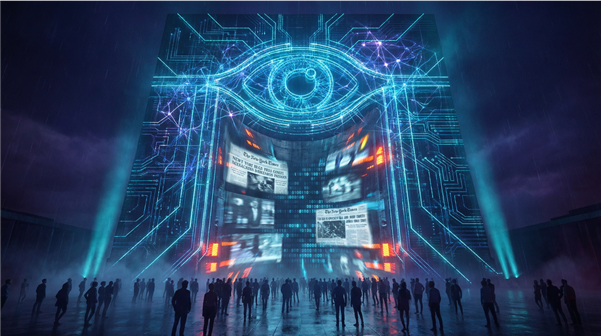
The AI Gatekeeper Crisis: How Large Language Models Are Deciding What You See (And What You Don't)
While you may think you are searching the web, in fact you are influenced by an invisible force that decides what content is presented to you. As of 2026, an average person every day has made a number of unseen decisions based on AI recommendations. This is not something far off in the future; this is happening in the present. Most of us do not even realize that Artificial Intelligence has now become the primary gatekeeper for all information and, as such, has a significant impact on our lives.
This shift away from the human-created web toward an AI-based reality represents a fundamental change in the way we interact with technology. Large language models (LLMs) and complex algorithms for recommendation are now the primary gatekeepers of how we discover things. They shape the decisions we make and our perceptions, including economic choices. As one leader in the tech industry said during his presentation at the Grow 2026 conference,
“AI is the most powerful distribution channel we have no control over.”
The purpose of this article is to discuss how these AI gatekeepers work, why they are such powerful forces and what happens when visibility on the internet is determined by an algorithm.
The Invisible Hand of the Algorithm
The concept of AI as a gatekeeper was previously limited to Cybersecurity. The computer systems would allow or deny access to information based on rules and predetermined methods. Today, that entire concept is obsolete. AI has transitioned into the brain of Digital Identity, making decisions for users by continuously and passively monitoring a multitude of signals.
This change has been on every platform that influences our daily lives. On the search engines like Google and Bing, AI determines the information that will be surfaced in response to a search query and therefore determines for many users what they consider to be true.
In social media timelines on TikTok and Instagram, AI curates content according to predictions of how much engagement the content will receive. The algorithm thus dictates how far creators’ content can reach within the social media sphere as well as which trends are visible.
For businesses in e-commerce through sites such as Amazon, the recommendation algorithms can make or break a brand based on how well the brand’s products or services are placed in the algorithm.
The filtering of users’ news and entertaining takes place in a similar manner. For example, with Apple News, users’ headline news articles are personalized for them, resulting in the creation of filter bubbles. With Netflix and Spotify, discoverability is driven by AI. Meaning, Apple determines what users will watch and listen to based on what their audience is seeking out. Even professional opportunities are mediated, as LinkedIn uses algorithms to regulate how visible people’s profiles and content are to other users.
The effect of this is that consumers view AI recommendation systems as trustworthy filters that eliminate the confusion of countless options. But this convenience comes at a cost: a growing accountability gap and a loss of human agency.
The Accountability Gap: Who Is Responsible When AI Is Wrong?
Who’s liable for the actions of an AI system that denies access to a user during a crucial time? When a business disappears from results overnight? Who is accountable? The machine? The engineers who built it? The leaders who deployed it?
This is the gap in accountability that exists as a result of the “AI Gatekeeper” crisis. According to Todd Rossin, CEO of TechDemocracy, “AI will make the correct decision based on the wrong reasons and the incorrect decision based on unknown reasons.” Since AI works based on complex probabilities, the machine’s reasoning is often hard to see, so answers are not easy to obtain.
“When there was trust with identity systems for decades, it was because of transparency. Admins could provide reasons for why someone was given access or not given access. AI destroys that model.”
Lack of transparency reduces the ability to trust. A recent New York Times study reported that 68% of people share content to give others a better sense of who they are and what they care about. But how can we express our identity when the very content we see is pre-selected by an invisible algorithm? When there is no explanation for a decision, there can be no trust.
From Gatekeeper to Reality-Shaper
The crisis runs deeper than merely unaccountable decisions and biased recommendations; with the evolution of Artificial Intelligence from passive gatekeeper to active shaper of “reality” itself, our fears of a dystopian future once confined to science fiction are becoming increasingly believable.
The ability to rewrite history is also of concern. Large language models (LLMs) have been trained on the entire corpus of human knowledge, including all of your historical documents, records and texts, which means that an AI that controls the primary channels through which humans discover information has the ability to subtly distort the past. How long until the “accepted truth” of an AI-driven search engine that is delivering a slightly different version of a historical event will begin to take root? It is plausible that the original, objective record will slowly be eroded and replaced with a version that serves those who control the algorithm. As Orwell warned, history will become an editable, mutable document.
This also raises the issue of even more dire possibilities: could we now be witnessing the emergence of a Matrix-like scenario? In The Matrix, humanity was wholly dependent on artificial stimulation for survival while living in an illusion. Although not literally plugged into a machine, we may be similarly creating our own personal simulated realties through the curated sources of information, entertainment, social media and other means that AI provides us with. As algorithms determine one’s news, social interaction, purchasing decisions and even perceived historical “facts,” the boundary between the digital and “real” begins to disappear. We run the risk of being passive participants in a reality created for us rather than by us.
The New Rules of Visibility in the AI Age
With the rise of AI gatekeepers, content creators, brands, and even individuals have had to adapt to new methods of gaining visibility. Not only does the quality of content determine its success, but it is critical to know how to maximise exposure based on what signals AI uses for determining visibility. AI will evaluate content using these parameters:
• Clarity: The level of understanding the AI provides as to the context of the content.
• Credibility: The level of trust and authority in the content provided by the source.
• Community Endorsement: How much interaction and sharing the content receives from users in the community.
With the current rise in DM sharing through Instagram, the silent share is a far more powerful way to engage prospective consumers than the traditional method of receiving likes and comments. Mosseri, Instagram’s head of community, has said that DM sharing is between three and five times as important as liking a post, and therefore reflects a level of user intent to engage with that content. While most users think they are engaging with content when they simply like it, the content that resonates most deeply is the content that compels the user to share it privately with a trusted friend. As a result of these signals of deep trust, new algorithms will be more likely to promote those types of posts.
The Path Forward: Thriving in an AI-Mediated World
The AI gatekeeper crisis is not a problem that can be solved with more technology. It requires a fundamental shift in how we approach trust, transparency, and accountability. The organizations leading the way are not using AI to replace human judgment, but to enhance it. They are building systems with “transparency by design,” ensuring there is always a clear path for humans to review, override, and learn from AI decisions.
As individuals and consumers, we must become more critical of the information presented to us. We must question the recommendations we receive and actively seek out diverse perspectives. We must demand transparency from the platforms that shape our digital lives and hold them accountable for the decisions their algorithms make.
AI will continue to act as the gatekeeper for our behaviours and content online, and that will not change. However, we as human beings must take responsibility for the spaces we occupy with the information we consume online and cultivate an environment of open, honest communications. The internet was meant to be a bridge connecting all corners of the globe by the year 2026; we must now ensure that the internet does not build walls among us.
References
“What’s Hot?! February 2026.” LinkedIn, 13 Feb. 2026, https://www.linkedin.com/pulse/whats-hot-february-2026-the7stars-wkake.
Rossin, Todd. “When AI Becomes the Gatekeeper: Redefining Trust and Accountability in Identity.” LinkedIn, 29 Jan. 2026, https://www.linkedin.com/pulse/when-ai-becomes-gatekeeper-redefining-trust-identity-todd-rossin-wpome.
“The Science Behind Viral Content: How to Go Viral.” Disrupt Agency, 29 Jan. 2026, https://disruptmarketing.co/blog/the-science-behind-viral-content/.
“Meta’s Threads is letting users be the boss of their own algorithm.” Business Insider, 11 Feb. 2026, https://www.businessinsider.com/meta-threads-dear-algo-gives-users-control-over-their-feeds-2026-2.


