


The highest form of intelligence isn’t what you know, it’s how you watch your own mind at work.
Recently, a @LeadersJunction X post went viral with an audacious and shocking statement: “The highest level of intelligence (according to neuroscience)!!!
The 2-minute video does not discuss astoundingly high IQ scores, extraordinary photographic memories, or the incredible speed at which someone can solve problems, but rather something that is much more subtle, significantly more powerful in our increasingly distracted society, and getting harder to find these days with all of our distractions. It is called, metacognition. This is the awareness of your own thoughts, the ability to question your own beliefs, and the ability to notice when you have made an error in your thinking. And all of it in real-time. And then consciously direct your own thinking to the right direction.
The video has gathered millions of views on YouTube, Instagram, and X since it was first posted several months ago. Is this simply another motivational message, or is there true scientific backing for what they are saying?
Not only there is true scientific backing for this video, but developing this skill is the best way to combat our growing obsession with emotionally based responses instead of rational thinking, and the fact that so many people are not discussing a method to develop this skill only serves as evidence that the current climate of self-improvement is at an all-time low.
What Exactly Is Metacognition?
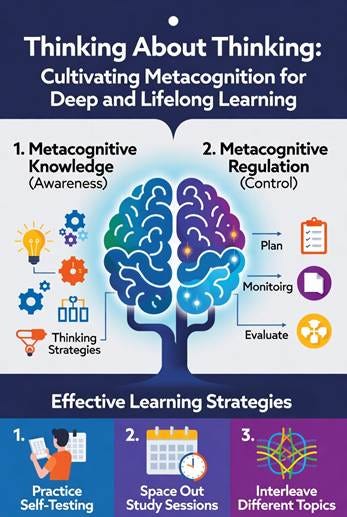
The term “metacognition” was initially introduced in 1976 by John Flavell, who is credited with being the first person to conceptualise the idea.
Metacognition deals with how well we understand ourselves in terms of our strengths and weaknesses as well as the way we use strategies to maximise our potential.
Additionally, metacognitive regulation involves the continual assessment of one’s thinking and the development of plans for improving one’s thinking. Examples of this would include realising that you are becoming lost in negative thoughts and then rationally coming up with an alternative view. Another example is recognising distractions and guiding your focus back to the task at hand rather than blaming outside forces for being distracted.
Finally, evaluating why a mistake was made and coming up with an answer to the question: “What assumptions did I make that led me to make this choice?” rather than blaming external forces.
The last example is an increasingly rare skill set, as our current society encourages individuals to hold others accountable for their own actions, making victimhood a virtue ...
The Neuroscience: Why the Prefrontal Cortex Is Key
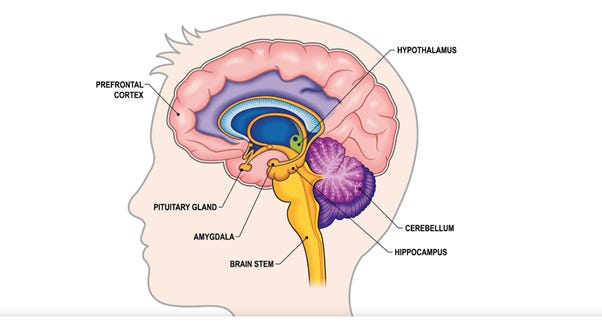
Modern brain imaging and lesion studies consistently point to the anterior prefrontal cortex (also called the rostrolateral or frontopolar PFC) as the neural headquarters for metacognition.
Through structural MRI studies, there is evidence that individuals who have greater gray matter volume or better connectivity in this area generally have higher accuracy scores on tests measuring metacognitive ability. Likewise, individuals with lesions in the anterior PFC, even if their perception and memory remain intact, will exhibit impaired levels of metacognition. TMS studies further establish the causal role of the anterior PFC in the development of metacognitive judgment and provide evidence that TMS of the anterior PFC disrupts an individual’s ability to reflect on his or her metacognitive performance.
Studies on DLPFC and precuneus have also confirmed that both of those areas assist in some aspects of metacognition; however, it is clear that the anterior PFC is especially important for enabling awareness of one’s own thoughts and feelings rather than functioning only as a way for one to exhibit how one thinks or feels about the world.
So, while other regions like the dorsolateral PFC and precuneus also play supporting roles, the anterior PFC stands out for its unique job: letting you reflect on your own mental states rather than simply being a slave to them.
Researchers use “metacognitive sensitivity” scores, that is how well your confidence matches your actual performance, and repeatedly find the anterior prefrontal cortex at the centre. The brain has a built-in mechanism for self-observation. So, the only questions is whether you choose to use it.
Does It Really Outperform IQ?
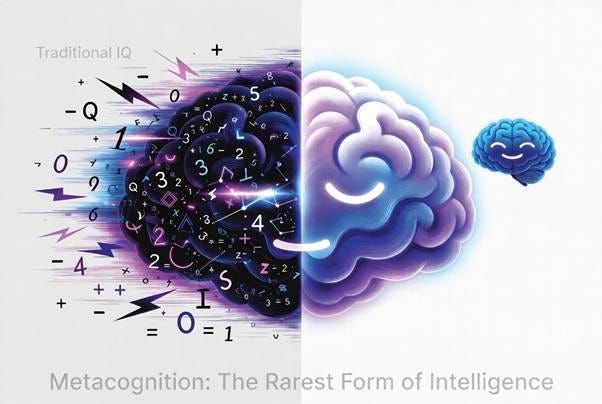
Here’s where the viral claim gets interesting and mostly correct.
Multiple large-scale studies in education show that metacognitive skill predicts academic success better than looking at the IQ score in many cases.
The Metacognitive Ability still accounted for a considerable amount of variance in School Performance.
Students who monitor their learning (e.g., using self-testing, spacing, and reflection) outperform equally smart peers who don’t.
To translated this to real-world terms, high metacognition helps you to:
Learn faster and retain more information
Adapt to new situations and new environments
Recover from mistakes without damaging your … ego
Develop better emotional regulation and resilience
This is the reason some Neuroscientists and Educators refer to Metacognition as the “Master Skill of the Human Mind.”
The Hype Check: Is It Literally the Highest Form?
Without ranking one ability as the highest, neuroscientists consider intelligence to be multidimensional and that various types of intelligence such as general intelligence (the G Factor), emotional intelligence, executive functions, creativity, etc., interact with one another in complex ways.
The viral phrase “highest form... according to neuroscience” is a classic example of pop-science marketing. While the concept of metacognition is directionally accurate and inspiring, no professional scientific institution has developed or published an official “ranking”.
That said, metacognition is a highly advanced cognitive function that is both rare and educable, and it builds off of other types of cognitive functions rather than replacing them. However, considering that we live in an information-overloaded world and that AI is better than humans at pure computational functions, the ability to manage how a person thinks could potentially be the most unique ability left to mankind and also the most useful in a practical sense. The statement made in the viral post was true, but oversimplifies the complex nature of the neuroscience behind it.
How to Actually Develop Metacognition (Yes, It’s Trainable!)

The best news: unlike fixed IQ, metacognition can be strengthened with practice. Here’s what works:
Mindfulness Meditation — The most evidence-backed method. Regular practice increases activity and connectivity in the anterior PFC and improves metacognitive accuracy. Even 10–15 minutes daily helps you observe thoughts without getting lost in them.
Daily Reflection Questions
“What did I believe today that might not be true?”
“Where did my attention wander, and why?”
“What strategy worked (or failed) and what can I adjust?”
Self-Testing & Error Analysis — Instead of passive re-reading, actively quiz yourself and analyze wrong answers. This builds metacognitive monitoring.
Journaling — Keep a “thinking log” after important decisions or arguments.
Final Thought
The X post illustrates the most authentic human characteristic. With mankind now having more access to information than ever before and with AI being capable of performing more computations than humans can ever do, one of the rarest superpowers that a person has is the ability to observe and think about your own thinking patterns.
To be clear, one does not magically become a genius because of metacognition. However, one can become wiser and calmer, more flexible, and more effectively utilise what intelligence they possess.
So, to start with small steps, the next time your mind is racing, stop and think to yourself something along the lines of “What am I currently thinking about… is this thought actually helping me?”
That one small act of being metacognitive is probably going to be one of the most intelligent things you do for the day 😊.